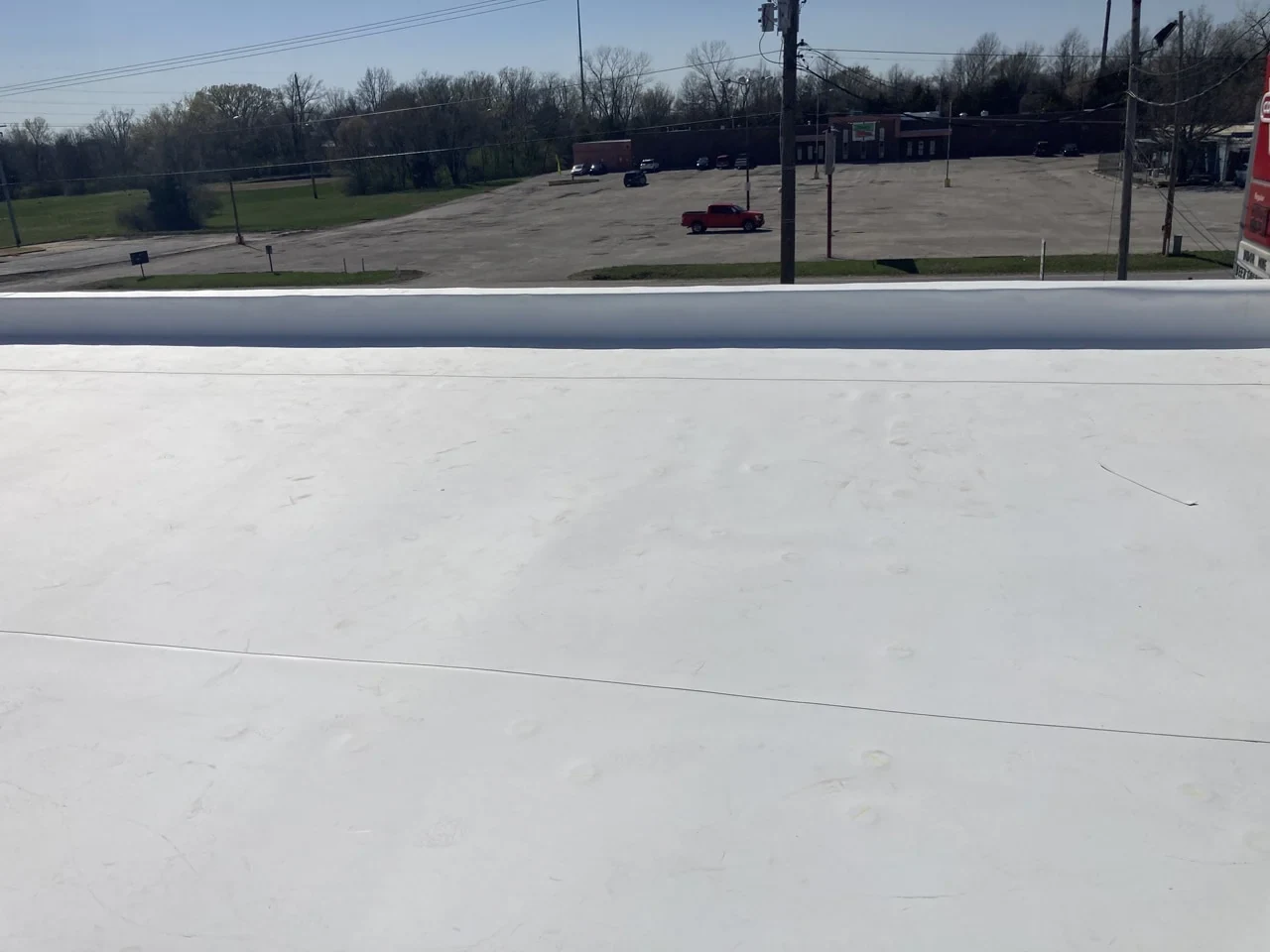
80 Mil TPO Roofing in Bend, OR
80 mil TPO for Bend roofs carrying heavy snow loads and rooftop equipment, built for higher puncture resistance under repeated winter service traffic.
80 Mil TPO for Roofs Carrying Snow Load and Winter Traffic in Bend
Eighty mil TPO earns its place on Bend roofs that see more than a quiet annual inspection walk. Brewery mechanical decks, hotel rooftop equipment near the Old Mill District, and light-industrial buildings with regular service access all put more wear on a membrane than a typical retail box, and the extra mass in 80 mil holds up to that traffic better than the lighter gauge does.
When the Extra Mass Earns Its Keep
The jump from 60 to 80 mil isn't about chasing a longer warranty number on paper. It's puncture resistance and membrane mass, and those matter most on a roof that gets walked regularly - HVAC techs servicing rooftop units, brewery staff checking exhaust equipment, or maintenance crews clearing pine needles and juniper debris out of parapet corners before fire season. A membrane that sees boots on it every month needs more mass than one that gets checked once a year.
We size membrane thickness to how a roof actually gets used rather than square footage or building type alone. A distribution roof out toward Juniper Ridge with minimal traffic can often stay on 60 mil. The same footprint with a growing list of rooftop conduit runs and quarterly service visits usually justifies the move to 80 mil, since the added cost is small next to the cost of an early recover.
Snow Drift Load Against Parapets and Curbs
Central Oregon winters push drifting snow against parapet walls, mechanical curbs, and any roof-level obstruction, and that drift load concentrates weight and moisture in specific spots rather than spreading it evenly across the field. Eighty mil membrane resists the abrasion and flex fatigue that comes from repeated freeze-thaw cycling under a drift better than a lighter gauge does, particularly at inside corners where snow tends to pile deepest.
We also watch how meltwater moves off those drift zones during warm afternoons. A membrane can be sound and still take on stress if drainage beneath a drift zone can't keep pace with the melt, so drain and scupper sizing gets checked alongside membrane spec on every 80 mil job.
Rooftop Equipment on Brewery and Hospitality Buildings
Bend's brewery and hospitality sector carries more rooftop equipment than a typical office building - exhaust fans, refrigeration condensers, sometimes temporary kitchen equipment during a remodel or seasonal push. That adds up to more foot traffic and more penetrations than the roof was maybe originally designed around, especially on buildings that have grown their mechanical footprint over several years of business.
Eighty mil membrane holds up better to that pattern, but we don't rely on thickness alone. We add walkway pads at established travel paths between the roof hatch and the equipment being serviced, which keeps wear concentrated somewhere we can inspect and patch without opening up the whole field.
Puncture Resistance During Winter Service Calls
Winter service calls on a Bend commercial roof often mean a tech working around ice, wearing bulkier gear, and moving equipment or tools across the membrane in conditions where footing is less certain than a summer service visit. Eighty mil's added puncture resistance gives more margin for that kind of unplanned contact than a lighter membrane would.
We factor that into our recommendation for any roof with equipment that needs regular winter attention, beyond just roofs with year-round traffic. A rooftop unit that only needs servicing twice a year, but always in the coldest months, still benefits from the heavier gauge.
Comparing 80 Mil Cost Against Recover Timing
We'll tell an owner directly when 60 mil is the smarter spec - 80 mil costs more, and there's no reason to pay for mass a roof doesn't need. But on roofs where we're already anticipating a recover cycle driven by traffic or equipment wear rather than membrane age, the math often favors the heavier gauge upfront.
A few factors we walk through with owners when comparing the two:
- Frequency of rooftop access for maintenance, HVAC, or equipment servicing
- Current and anticipated growth in rooftop mechanical equipment
- Manufacturer wind uplift rating requirements for the building's exposure category
- History of punctures, patches, or storm damage on the existing roof
- Whether the building carries insurance requirements tied to membrane thickness
- Budget timeline for the next planned reroof or recover cycle
Fastening Density on Larger Low-Slope Roofs
On bigger roofs - hotel footprints, distribution buildings, multi-tenant retail - wind uplift performance depends on more than membrane gauge alone. Fastening density in field, perimeter, and corner zones, cover board type, and deck attachment all factor into how the assembly performs during a high-wind event, which Central Oregon sees regularly during fall and spring transitions.
We calculate uplift zones specific to each building rather than defaulting to a standard pattern, since parapet height and surrounding structures change a roof's actual wind exposure even between buildings a short distance apart.
Questions From Bend Facility Managers
Is 80 mil TPO required by code for buildings at this elevation?
No, thickness requirements come from manufacturer wind and puncture ratings or insurance carrier specs, not elevation alone. Plenty of quiet-roof buildings in Bend do fine on 60 mil.
Does 80 mil hold up better to snow load than 60 mil?
Both thicknesses can be engineered to carry the same structural snow load - that's a framing and deck question. Where 80 mil helps is resisting abrasion and fatigue at drift zones and high-traffic spots near equipment.
How much more does 80 mil cost compared to 60 mil?
It varies with roof size and fastening requirements, but the difference is usually modest relative to the full project cost. We price both thicknesses side by side whenever a roof could reasonably go either way.
Do walkway pads matter if we already have 80 mil membrane?
Yes, especially on winter service routes. Thickness resists punctures, but walkway pads concentrate wear on a surface built to take it and protect the rest of the field.
Can 80 mil TPO be installed as a recover over an existing roof?
Sometimes, depending on the condition of the deck and insulation underneath. We check for wet insulation and structural soundness with core cuts before recommending a recover over a full tear-off.
Related
Ready to review the roof scope?
Request a Roof Assessment